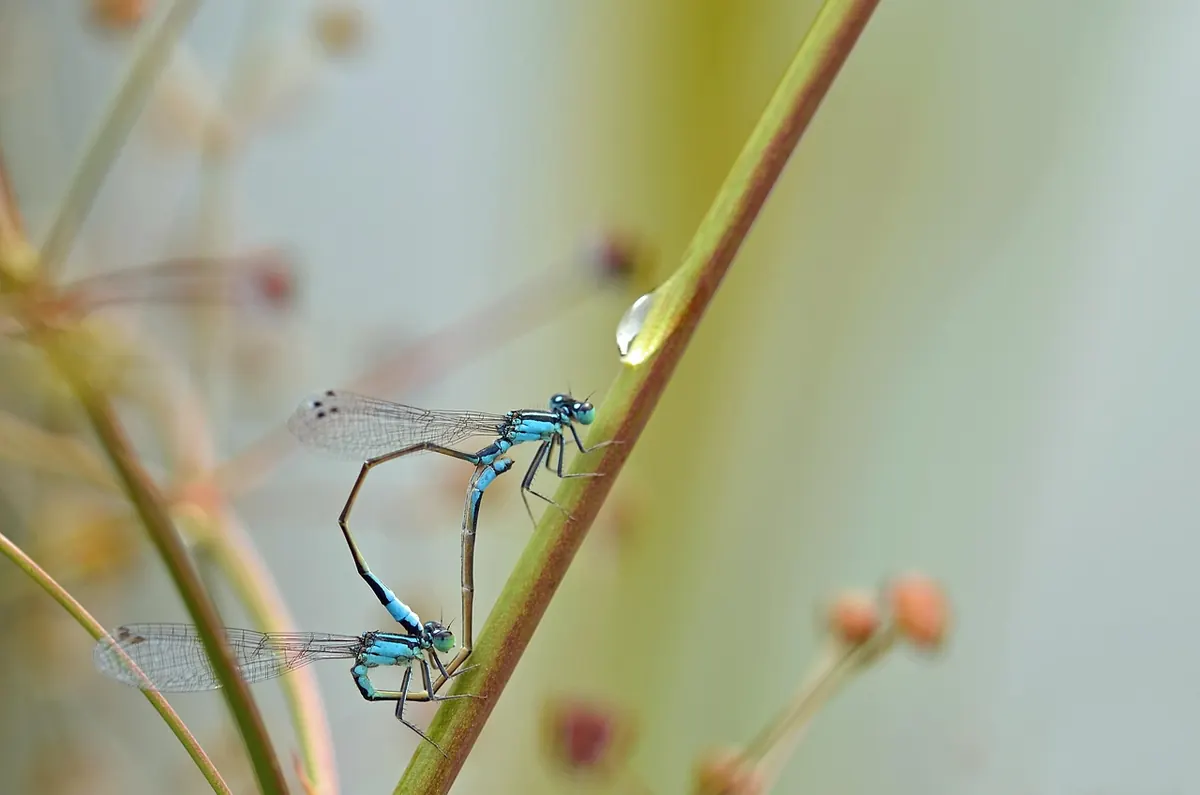
Somewhere between late May and August, a walk around a wetland suddenly gets busy. A blue needle of a body lifts off a reed stem; something bigger hovers over open water, then snaps sideways after prey too small to see. Dragonflies and damselflies can look baffling at first, but they are among the most approachable insects in Britain. They are large, they return to the same perch, and they give you time to look properly.
This is a beginner's route in: the features that matter, the species you are most likely to meet at a marsh, pond or canal, and how the date in your notebook can do half the identification work.
Dragonfly or damselfly? Three rules that settle it
Both belong to the order Odonata, and both spend the first part of their lives underwater as nymphs, hunting other invertebrates among the mud and weed. When the time comes, they climb a stem, split their skin and pump up their wings. The adults you see on the wing fall into two groups.
- Wings at rest. Damselflies usually fold their wings back along the body; dragonflies hold theirs out flat, like a glider. The exception is the demoiselles, which sit with wings half open.
- The eyes. A damselfly's eyes sit wide apart on either side of the head, like the ends of a dumbbell. A dragonfly's are huge and usually meet in the middle.
- The flight. Damselflies flutter weakly and stay close to vegetation. Dragonflies are fast and direct, often patrolling a long stretch of water or hedge.
The species you are most likely to meet
Damselflies
Large red damselfly is the one to learn first: red and black, small, and often the earliest damselfly on the wing from April. Azure and common blue damselflies are the blue ones swarming over the water in midsummer, and they are genuinely hard to separate without a close view or a photograph. Blue-tailed damselfly is easier, a black body with one bright blue segment near the tip, often resting on lily pads. Banded demoiselle is the showy one: a metallic blue-green male with a broad dark band across each wing, fluttering along slow rivers, canals and dykes.
Dragonflies
Four-spotted chaser is brown and medium-sized, with a dark spot at the base and at the node of each wing; it favours ponds with plenty of emergent vegetation. Broad-bodied chaser has a broad, flattened abdomen with yellow spots along the sides. Emperor dragonfly is the big patroller of open water in June and July, blue with a green thorax. Southern hawker is black with green and blue spots, often away from water along hedges, and will hover close to inspect you. Common darter perches on fence posts, gravel and bare ground, darting out after prey and returning to the same spot; males are red, females yellowish-brown. Ruddy darter is a deeper red with a waisted abdomen and all-black legs.
The flight season is a clue
Beginners tend to identify from colour alone. The date narrows the field faster.
- April and May: large red damselflies, the first demoiselles, the earliest chasers.
- June and July: peak season, emperors over open water, blue damselflies in the margins, four-spotted and broad-bodied chasers on the wing.
- August: hawkers and darters take over, migrant hawkers arrive and numbers build.
- September and October: common and ruddy darters linger on warm days, and southern and migrant hawkers hunt on into autumn.
A blue damselfly in late September deserves a second look; most common blues will have gone by then.
How to get a proper look
Odonates are wary of movement and shadow. A little care turns a glimpse into a good view.
- Choose a warm, still, bright day and go between late morning and mid-afternoon. Wind and cloud keep most species settled in the vegetation.
- Approach slowly and keep your shadow off the perch. Many dragonflies tolerate a slow approach but not a sudden one.
- Use close-focusing binoculars if you have them. A pair that focuses down to two metres beats high magnification here.
- Watch before you name. Does it patrol, or perch and return? Does it fly over the water or along the hedge?
- Photograph from the side and from above. Abdomen markings, wing patterns and leg colour are what separate the difficult pairs.
Pairs that trip everyone up
Azure and common blue damselflies. Look at the pattern on the second segment of the abdomen, nearest the thorax: azure usually shows a wine-glass shape, common blue a club or mushroom shape. If you cannot see it, take a photograph and check later.
Common and ruddy darters. Ignore the red and look at the legs. Common darter has pale stripes along its black legs; ruddy darter's are entirely black, and it looks narrower in the abdomen.
Southern and migrant hawkers. Migrant hawkers are smaller and later, typically from August, with blue and yellow spots; southern hawkers are larger, greener and often well away from water. There is no harm in recording something as "hawker, unidentified".
Starting a wetland list
You need no expensive kit and no expertise to begin. Pick one pond or stretch of boardwalk and visit it twice a month through the season, at roughly the same time of day. Learn the six species above properly rather than trying to hold twenty in your head, and note the date, the species and what the insect was doing. A list soon turns into a picture of the season.
Your records are useful beyond your own notebook. Wildlife organisations and county recorders depend on sightings from volunteers to track how these insects are faring, and wetland species respond quickly to changes in water quality, site management and weather. A photograph with a date and a location sent to the relevant recording scheme is a real contribution.
Watch the margins as closely as the water. Poached banks and trampled reedbeds cost a site far more than a missed identification ever will, and the best dragonfly watching is done standing still.
Photo: susannp4 / Pixabay